Symbol Adjacency Rules Shape Cluster Formation and Cascade Sequences in Modern Slot Designs
Paul Hartmann · Jul 18, 2026
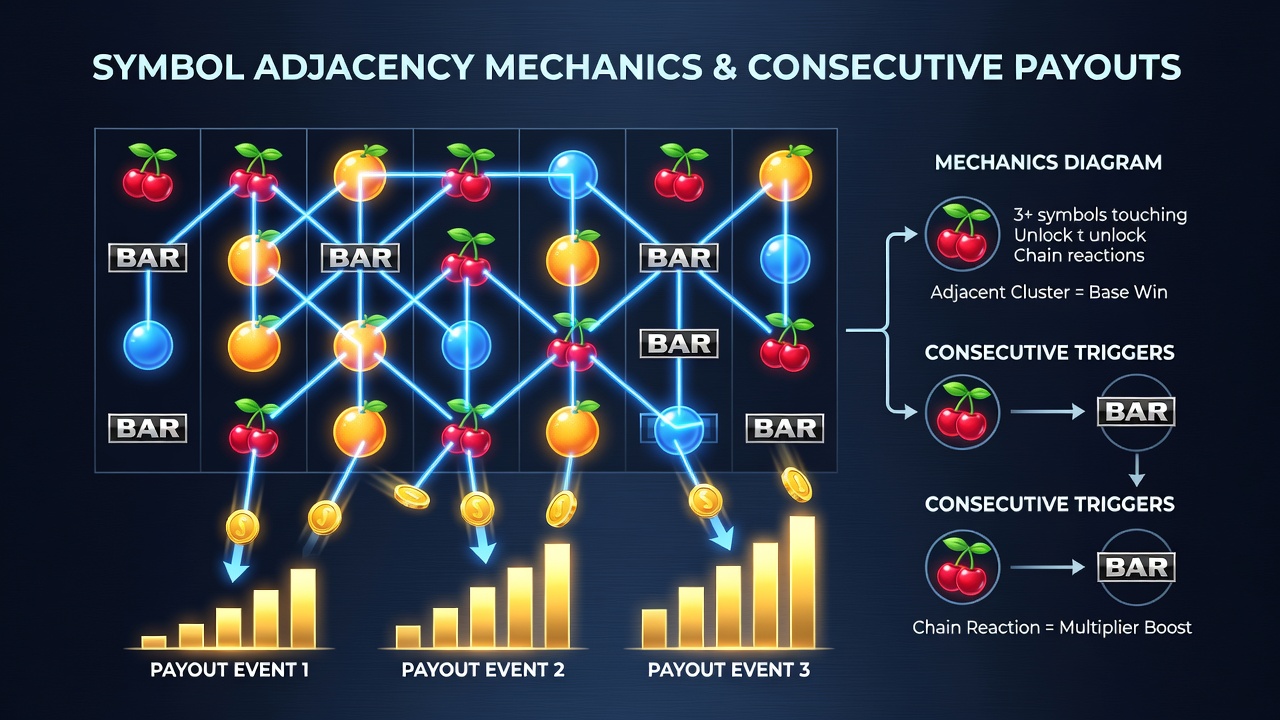
Symbol Adjacency Rules Shape Cluster Formation and Cascade Sequences in Modern Slot Designs
Cluster-pay slot machines rely on symbol adjacency to determine winning combinations instead of fixed paylines, and this mechanic directly influences how often consecutive payout events occur through cascading sequences. Adjacent symbols must connect horizontally or vertically in most implementations, although certain titles extend connections to diagonal positions as well. Data from industry analyses show that tighter adjacency requirements produce smaller but more frequent clusters while broader adjacency rules allow larger groups to form before any cascade begins.
Core Adjacency Definitions in Cluster Pay Systems
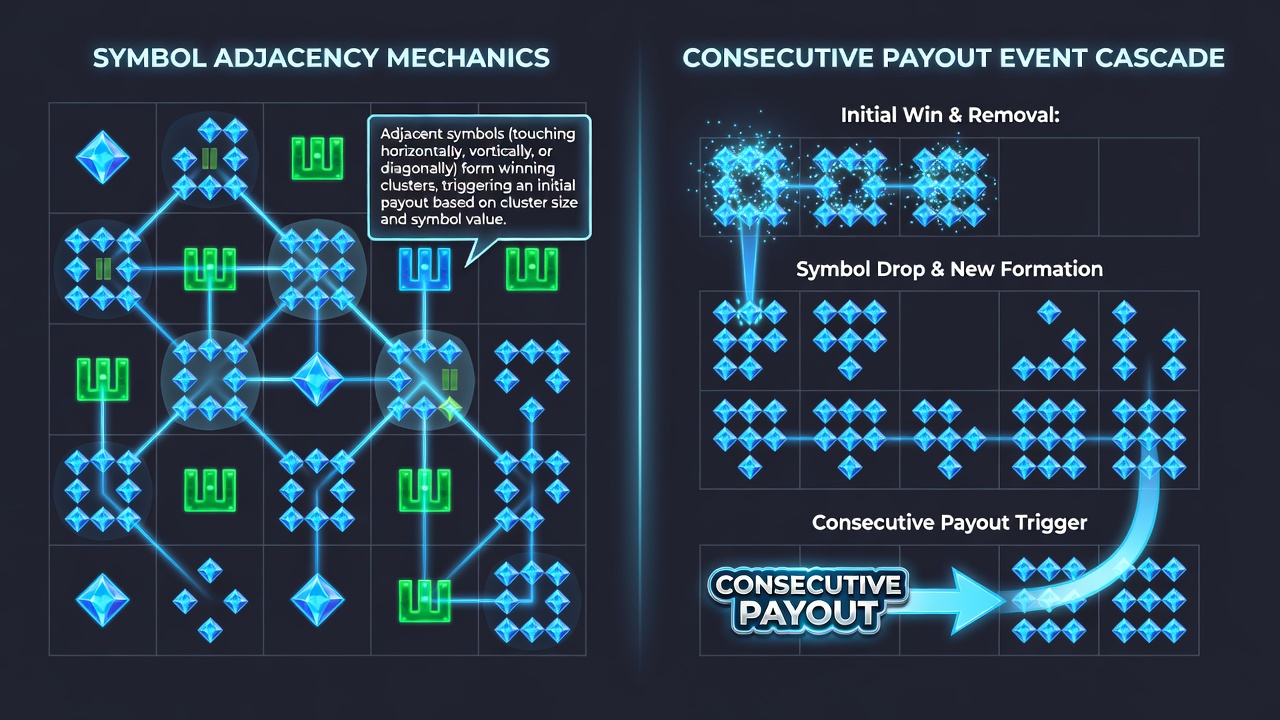
Game developers establish adjacency parameters at the coding stage where symbols register as connected only when they share edges on the grid layout. Horizontal adjacency covers symbols sitting side by side in the same row while vertical adjacency covers symbols stacked directly above or below one another in the same column. Observers note that these rules exclude diagonal placements unless the game explicitly codes them in which case eight-way connectivity becomes possible and cluster sizes increase accordingly.
Research from the University of Nevada Reno gaming laboratory indicates that eight-way adjacency models generate roughly 18 percent more clusters per spin than four-way models across comparable reel dimensions. The difference appears because diagonal links create additional pathways for symbols to join existing groups before payout calculation occurs.
How Adjacency Influences Consecutive Payout Events
Once a cluster pays out the symbols involved disappear from the grid and remaining symbols drop downward to fill gaps in a process commonly called a cascade. Adjacency mechanics affect the likelihood of new clusters forming after each drop because the new positions determine whether fresh symbols now touch each other. Tighter adjacency grids tend to produce shorter cascade chains since fewer connections survive the drop while looser rules allow symbols to remain connected across greater distances after falling.
Figures released by the Canadian Gaming Association in mid-2025 revealed that titles using six-way adjacency recorded an average of 2.7 cascades per winning spin compared with 1.9 cascades in four-way systems. Those numbers reflect data collected from operators across multiple provinces between January and June of that year.
Grid Size and Connectivity Patterns
Grid dimensions interact with adjacency rules to shape payout frequency. A 5x5 layout with standard four-way adjacency limits cluster growth more strictly than a 6x6 or 7x7 layout using the same rules because fewer total cells exist for symbols to align. Developers adjust these variables together so that larger grids often pair with stricter adjacency to maintain target return-to-player percentages.
One case examined by analysts at the Australian Institute of Gaming Research in 2024 demonstrated that expanding a grid from 5x5 to 6x6 while keeping four-way adjacency raised average cascade length by 0.4 events per spin. The study tracked over 2 million simulated spins across controlled test environments to isolate the effect of grid size alone.
Symbol Types and Their Role in Adjacency Chains
Wild symbols frequently modify adjacency outcomes because they substitute for other symbols and can bridge gaps between non-matching icons. When a wild lands adjacent to two different symbol types it may complete multiple clusters simultaneously depending on the ruleset. Scatter symbols operate outside adjacency requirements in many titles yet still trigger bonus rounds that often feature modified adjacency during free spins.
Reports compiled by the European Gaming and Betting Association document that games incorporating expanding wilds during cascades produce 23 percent longer consecutive payout sequences on average than equivalent titles without expansion mechanics. The association gathered operator-submitted performance metrics from across member states between 2023 and 2025.
Mathematical Modeling of Cascade Probability
Engineers calculate cascade probability using adjacency matrices that map every possible cell connection on the grid. Each matrix entry records whether two cells share an edge or corner according to the game's connectivity rule. During simulation runs the matrix updates after every drop to reflect new symbol positions and the process repeats until no further clusters form.
By July 2026 several testing laboratories had begun publishing standardized adjacency matrices for popular cluster-pay titles so operators could compare expected cascade lengths across different rule configurations. These matrices help developers predict how rule changes will affect hit frequency and average payout duration without requiring full game rebuilds.
Conclusion
Symbol adjacency mechanics establish the foundation for cluster formation and directly control how consecutive payout events unfold through cascading sequences in cluster-pay slot machines. Grid dimensions, connectivity patterns, wild behavior, and mathematical modeling each contribute measurable effects that appear consistently across operator data and laboratory studies. As platforms continue releasing new titles through 2026 these underlying rules remain central to understanding payout dynamics regardless of visual themes or bonus structures layered on top.