Tracing Blackjack's Path from Parisian Card Rooms to Contemporary Casino Floors
Devon Ludwig · Oct 5, 2026

Tracing Blackjack's Path from Parisian Card Rooms to Contemporary Casino Floors
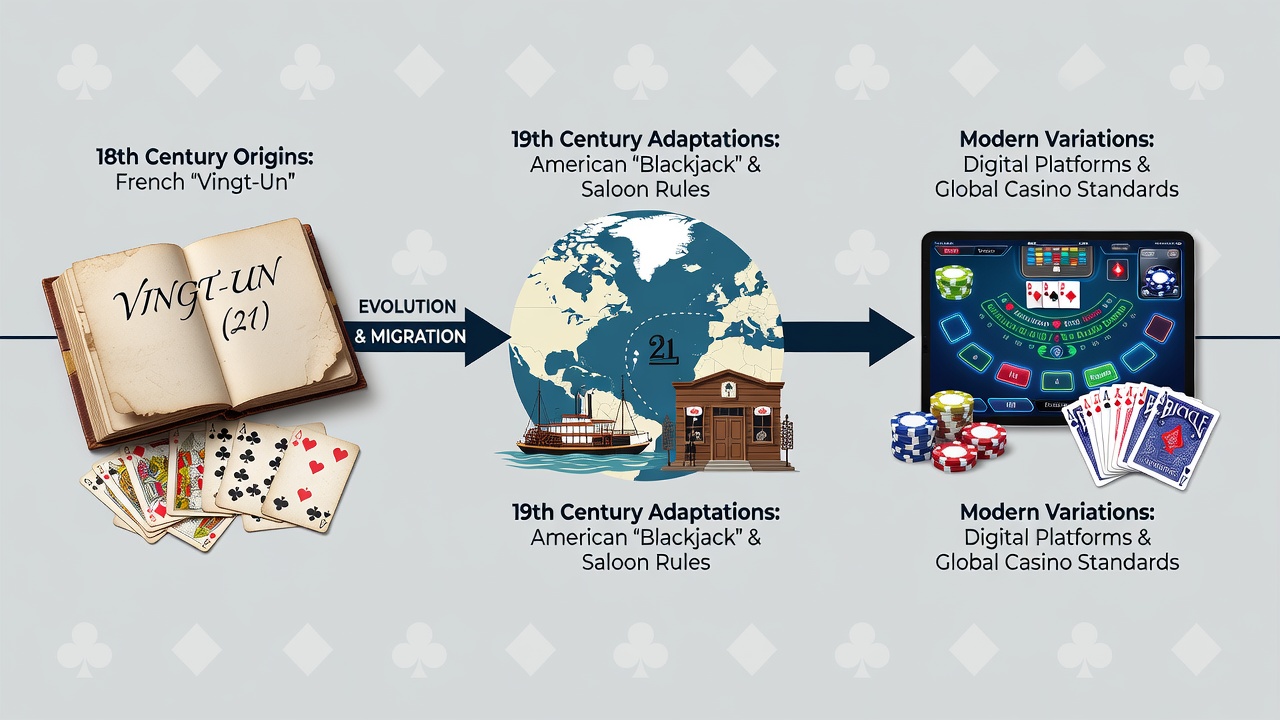
Blackjack traces its lineage directly to the French game Vingt-et-Un, which emerged in Parisian card rooms during the 1700s as a straightforward comparison game between players and a dealer, and historians have documented how core mechanics such as hand totals near twenty-one carried forward while later adaptations altered payout ratios and strategic options across regions.
Early French Foundations and Rule Basics
Players in those early French establishments received two cards and aimed to reach a total of twenty-one without exceeding it, with the dealer following fixed drawing rules that limited flexibility, and records from the period show that natural hands paid even money while the game spread through European salons before crossing the Atlantic in the nineteenth century. French rules emphasized simplicity with no doubling or splitting at first, yet observers note that these limitations shaped initial payout structures around fixed even-money returns on most winning hands.
By the late 1700s, variations began appearing in different cities where house rules allowed limited doubling on certain totals, and this early experimentation established precedents that modern designers still reference when calibrating risk and reward in table games.
Transatlantic Shifts and American Adaptations
Once the game reached the United States, casino operators introduced changes including the option to double down on any two cards and split pairs, moves that increased player agency while simultaneously adjusting the mathematical edge through modified payout schedules, and data from early Nevada gaming records indicates these additions raised average returns for skilled participants when applied correctly. The familiar three-to-two payout on natural blackjacks became standard in many American venues during the mid-twentieth century, creating a benchmark that later operators would challenge with six-to-five alternatives in single-deck formats.
Key Rule Changes and Their Payout Impacts
Modern variations such as Spanish 21 eliminate all tens from the deck while offering bonuses for specific combinations, and these modifications reshape payout structures by introducing progressive side bets that can exceed base game returns under certain conditions. Double-deck games often restrict doubling to specific totals, a restriction that operators implement to balance the reduced house edge created by fewer cards in play, and studies conducted by the University of Nevada, Reno have quantified how such limits affect long-term player outcomes across thousands of hands.
Rule adaptations continue to influence payouts because each tweak to drawing procedures or splitting permissions recalibrates the probability distribution of final hands, and regulatory bodies including the Nevada Gaming Control Board require operators to submit mathematical models demonstrating that proposed changes maintain compliance with approved return-to-player thresholds. In Canada, provincial gaming authorities apply similar oversight to ensure that regional blackjack variants preserve transparency around payout percentages even as new side bets proliferate.
Contemporary Variations and Ongoing Adjustments
Today operators deploy games such as Blackjack Switch and Pontoon that invert traditional hierarchies by allowing players to swap cards between hands or by awarding different bonuses for five-card totals, and these departures from eighteenth-century baselines demonstrate how incremental rule shifts sustain player interest while preserving house margins through recalibrated payout tables. Multi-hand formats popular in online environments further extend the lineage by permitting simultaneous play across multiple positions, a development that traces back to early French allowances for multiple participants at single tables yet incorporates digital random number generators to standardize outcomes.
Evidence from industry reports compiled by the American Gaming Association shows that payout structures in current blackjack offerings vary significantly by jurisdiction, with some markets mandating minimum three-to-two returns on naturals while others permit six-to-five compensation in exchange for additional player-friendly rules such as late surrender. These trade-offs illustrate the continuing dialogue between historical precedents and contemporary commercial requirements.
Conclusion
The progression from Vingt-et-Un in French card rooms to today's diverse blackjack catalog rests on successive rule adaptations that have consistently recalibrated payout structures to balance risk, and archival evidence combined with modern regulatory filings confirms that these modifications remain central to how the game evolves across different gaming environments.